Before You Buy Anything — Choose the Right First Trip
The most common first-timer mistake is buying too much gear before choosing where to go. Your first camping trip should drive the gear list, not the other way around. A beginner doing Shivpuri near Rishikesh in October needs completely different equipment from someone doing Rajmachi in July.
For your first trip, aim for these criteria: within 300km of your home city, easy difficulty, well-established campsite with some infrastructure (toilets, drinking water), and a season that doesn't demand technical gear. Coorg, Shivpuri and Rajmachi (September–October) all fit this profile perfectly.
Once you have your destination, work through this checklist.
The Complete Gear Checklist
Shelter
- Tent — For a first trip at an established site, you can often rent. If buying, the Quechua MH100 (₹2,999) is the right starting point. Don't buy a tent before practising the setup at home.
- Sleeping bag — Match the temperature rating to your destination. For Coorg or Rishikesh in October, the Forclaz Trek 500 0°C (₹3,999) is ideal. Wear a thermal base layer inside.
- Sleeping mat — Often overlooked. Cold ground conducts away body heat faster than cold air. A foam mat (₹299 at Decathlon) makes a significant difference to sleep quality.
Clothing
- Moisture-wicking base layers — Avoid cotton next to skin. It absorbs sweat and stays wet. Decathlon's synthetic or merino layers work well.
- Mid layer — A fleece or down jacket for evenings. Even in October near Rishikesh, temperatures drop to 12–15°C after dark.
- Outer layer — At minimum, a basic waterproof jacket. Pack it even if no rain is forecast.
- Trekking trousers — Quick-dry synthetic. One pair for hiking, one dry pair for camp.
- Warm hat and gloves — Evenings are colder than you expect, especially above 1000m.
- Dry change of clothes — Sealed in a dry bag. Non-negotiable.
Footwear
- Trekking shoes — The Quechua NH500 Mid (₹4,999) covers most first-trip scenarios. Wear them around the house for a week before the trek to break them in. Blisters from new shoes are the most preventable camping problem.
- Camp sandals or flip-flops — For moving around camp. Your feet need rest after a day of hiking.
- Spare socks — Two extra pairs minimum. Wet feet cause blisters; cold feet ruin sleep.
Navigation and Light
- Headlamp — Not a torch. Both hands need to be free at night. Decathlon sells reliable headlamps from ₹299. Carry spare batteries.
- Offline maps — Download your route on Maps.me or AllTrails before you leave. Mobile data is unreliable on most Indian trails.
- Physical trail description — A screenshot or printout. Phones die; paper doesn't.
Food and Water
- Water bottles — Two 1-litre bottles minimum. Carry more in summer or high altitude.
- Water purification — Purification tablets (₹50 at any pharmacy) as backup. Stream water in India should always be treated.
- Trail snacks — Energy-dense, no cooking required. Nuts, chikki, energy bars, dry fruits. Carry more than you think you need.
- Camp meals — For a first trip at an established site, buy meals there or bring pre-cooked food. Leave the cooking equipment for trip two.
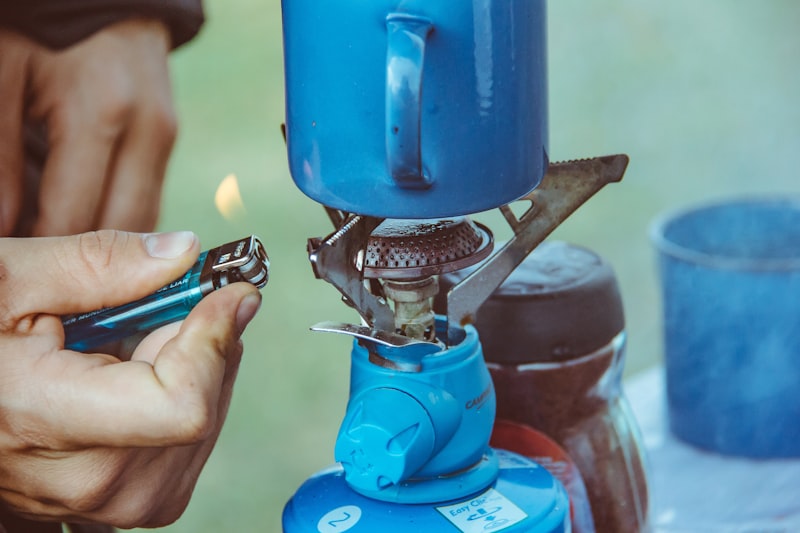
- Stove and gas (optional) — Only if you're confident. A Jetboil-style canister stove from Decathlon is the simplest option for camp cooking.
Safety and First Aid
- Basic first aid kit — Bandages, antiseptic, ORS packets, blister plasters, paracetamol, antihistamine. Decathlon sells a ready-made kit for ₹499.
- Whistle — Three blasts is the universal distress signal. Attach to your backpack strap.
- Emergency contact card — Written on paper in your bag: your name, blood group, emergency contact, and any medical conditions. Not on your phone.
- Fully charged power bank — 10,000mAh minimum. Charge your phone and headlamp before leaving.
- Lighter and matches — Both. In a waterproof bag.
Pack Organisation
- Backpack — The Quechua NH Arpenaz 30L (₹1,999) is right for a 1–2 night trip. A 50L pack is better if you're carrying a tent and sleeping bag.
- Rain cover for your pack — Most Decathlon packs include one. If not, a heavy-duty garbage bag works.
- Dry bags — Clothes, electronics and sleeping bag each in their own dry bag.
Permits — What You Need and Where to Get Them
Many Indian campsites and trails require permits. Getting this wrong means being turned back at the trailhead.
Forest department permits are required for treks inside national parks and wildlife sanctuaries — Kudremukh, Dzukou Valley, Valley of Flowers, Sandakphu. These are usually available at the park entry point or online via the state forest department website. Check 2–3 days in advance.
Nanda Devi Biosphere Buffer Zone — covers Roopkund and Valley of Flowers approaches. Permit from the local forest range officer or at Ghangaria for Valley of Flowers.
Inner Line Permits (ILP) — required for Nagaland (Dzukou), Manipur, Mizoram and Arunachal Pradesh. Available online for most states within 24 hours. Ladakh requires separate documentation for some restricted zones.
For most Maharashtra, Karnataka and Uttarakhand campsites, no permit is required. When in doubt, check with the campsite operator before travel.
The Night Before — Final Checklist
Run through this the evening before your trip:
- Phone fully charged, offline maps downloaded
- Power bank charged
- Headlamp batteries checked
- Sleeping bag and clothes in dry bags
- First aid kit packed
- Emergency contact card in bag
- Permits printed or downloaded offline
- Weather forecast checked
- Someone at home knows your route and return time
The Most Common First-Timer Mistakes
Overpacking — Every unnecessary kilo comes out of your knees on the descent. If you haven't used it on a day hike, don't bring it camping.
New shoes — Wearing brand-new trekking shoes on a multi-day trip is a guaranteed blister disaster. Break them in first.
Underestimating the cold — Even in summer, Indian nights at altitude are cold. A sleeping bag and a mid layer are non-negotiable above 1500m.
No offline maps — Mobile signal disappears within 2km of most Indian trailheads. Download your maps before leaving the city.
Starting too late — Always start your trek by 7am. Indian mountain afternoons bring heat, thunderstorms, or both. Be in camp by 3pm.
What to Expect on Your First Night
The first night under canvas is almost always harder than expected and better than expected simultaneously. The ground is harder than your bed. The sounds are unfamiliar — insects, wind, animals moving nearby. But the stars, if you're away from city light, are extraordinary. The air is clean. The silence, once you relax into it, is restorative in a way that's difficult to find anywhere else.
Give it until morning. Every first-time camper who has persisted through a slightly uncomfortable first night has woken up converted. The second trip is always better — you know what to expect, you've adjusted your kit, and you've stopped trying to replicate home in a tent.
Start simple. Go with a friend. Pick a well-known site close to home. The rest follows naturally.